
Welcome to the NCW Disaster Long Term Recovery Group, the organization charged with responding to the 2026 wildfires that impacted Okanogan, Chelan, Douglas, and Ferry counties, and including the Confederated Tribes of the Colville Reservation. We are here to coordinate and provide disaster case management and recovery services to individuals, families, businesses, and communities across North Central Washington that have been adversely impacted by wildfire disasters. We’re also here to help our region plan efficiently for strategic investments and actions so we’re better prepared for whatever comes next.
Our Story
Our organization began as Carlton Complex Long Term Recovery (CCLTR), formed in response to the largest wildfire in Washington history. We came together to provide coordination and recovery services to those who were adversely impacted by the 2014 wildfires that later resulted in mudslides across Okanogan County.
Following the 2015 wildfire season, the CCLTR evolved into the OCLTRG (Okanogan County Long Term Recovery Group) to expand recovery efforts to include additional wildfire-impacted communities across Okanogan, Chelan, Douglas, and Ferry counties, and including the Confederated Tribes of the Colville.
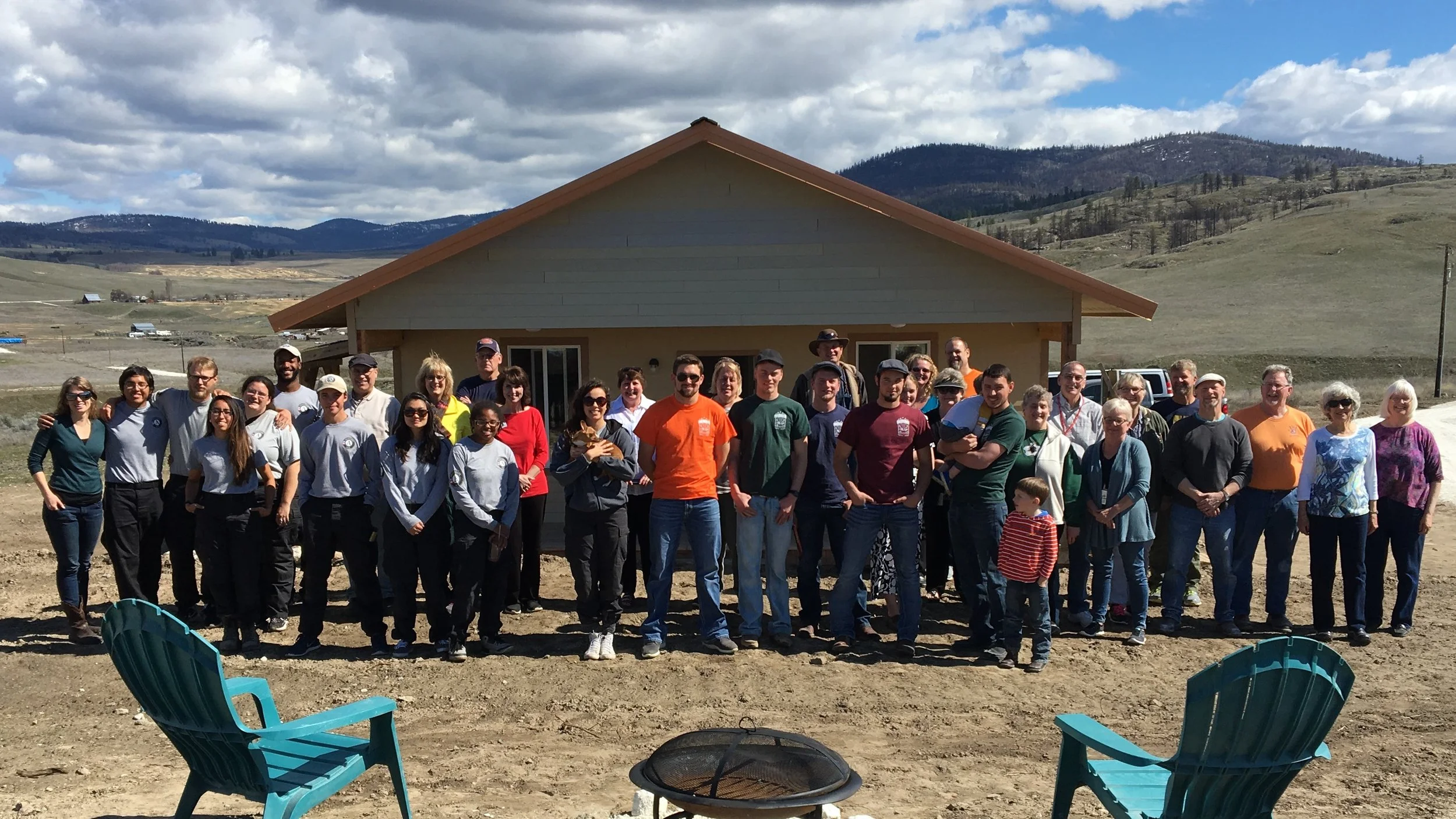
Today, as the NCW Disaster Long Term Recovery Group, our work spans Okanogan, Chelan, and Douglas counties — with additional support reaching into Ferry County — as we respond to the 2026 wildfires. To date, we have provided case management services to more than 1,600 families and individuals, helping with everything from site cleanup to fence and outbuilding reconstruction. We have rebuilt 47 homes and will continue rebuilding homes for residents who have no other means to do so.
If you have been displaced or otherwise impacted by the 2026 wildfires in North Central Washington and need help, please click here.
And if you would like to help—with money, time, or other resources—click here.
History
2014 — Carlton Complex Fire
The Carlton Complex Fire became the largest single wildfire in Washington State history, burning over 256,000 acres and destroying more than 300 homes in and around Pateros, Brewster, and rural Okanogan County. Despite the scale of the disaster, the community did not qualify for federal disaster relief. In response, local residents came together to form what would become this organization — proof that when larger systems fall short, community-led recovery can still get people home.
2015 — Okanogan County Fires
The very next year, the Okanogan Complex and Chelan Complex fires together burned nearly 400,000 acres. Washington State was declared to be in a state of emergency, and the lives of three firefighters were tragically lost while battling a fire near Twisp. Combined with the fires of 2014, more than 500 homes were destroyed across the region. It was following this season that the CCLTR grew into the OCLTRG, expanding recovery efforts beyond Okanogan County to neighboring communities.
2020 — The Labor Day Fires
In September 2020, wind-driven wildfires swept across North Central Washington, adding to a community already reshaped by the fires of 2014 and 2015. The Cold Springs Canyon, Palmer, and Pearl Hill fires, burning across Okanogan and Douglas Counties, grew from roughly 10,000 acres to 175,000 acres in a single day, forcing evacuations in Mansfield and beyond. Once again, families who had barely finished rebuilding faced fresh loss — and once again, this community showed up for itself. Recovery efforts expanded to meet the need, reinforcing what had already become clear: wildfire recovery here isn’t a single event; it’s ongoing work.
2026 — Chelan Hills, Kaiser Canyon, Sinlahekin, Little Giant, Modrite
These are the fires we are responding to at the moment—although fire season is not yet over.
This year’s fire season began in May 2026 with the Libby Creek Fire, followed by over 200 wildfires by June 12.
On July 4, there was a major ignition event. The Chelan Hills Fire was a catastrophic wildfire that began on July 4, 2026, in Douglas County, Washington, near Orondo. It rapidly spread uphill, destroying over 100 structures — including homes, outbuildings, and vehicles — and killing one person.
The Kaiser Canyon Fire, sparked by lightning on July 16, 2026, near Nespelem on the Colville Indian Reservation, was the largest wildfire in Washington state to date until the Sinlahekin Fire. As of August 11, the Kaiser Canyon Fire had burned about 138,218 acres, destroying an estimated 15 structures, though it is not yet determined how many of these are primary residences. As of August 11, it was 74% contained.
In northern Okanogan County, the Sinlahekin Fire is the largest currently burning wildfire in Washington State. It ignited on July 26, 2026, about 12 miles west of Tonasket, and had burned nearly 150,000 acres as of August 11, 2026.
The Modrite Fire in Ferry County, Washington, is a major wildfire that has grown significantly since it was first reported on July 17, 2026. As of August 12, 2026, it covered about 57,788 acres and was 62% contained.
The Little Giant Fire was discovered on July 16, burning in the Okanogan-Wenatchee Forest, reportedly caused by lightning. As of August 20, it had burned more than 138,000 acres, destroyed 26 structures, and was only 12% contained.

This image shows the areas affected by the '14 and '15 fires as well as the locations of our rebuild sites.
NCW Disaster TEAM
Carlene Anders - Executive Director
Jessica Farmer - Lead Disaster Case Manager
board of directors
Christa “Teagan” Levine - President
Patti Cockfield - Vice President
Michael Maltais - Treasurer
Katheryn Heim - Secretary
Naomi Peasley - Director
Maria Sanagria - Director
Jon Neal - Director